tag:neuroscienceandbehavior.nd.edu,2005:/news-and-events/newstag:neuroscienceandbehavior.nd.edu,2005:/latestNeuroscience and Behavior | News2026-09-18T08:13:00-04:00Notre Dame Neuroscience: Explore the brain & behavior. Interdisciplinary program offering diverse career paths in healthcare, tech, & beyond. BS/BA degrees prepare you for professional & graduate programs.tag:neuroscienceandbehavior.nd.edu,2005:News/1856192026-09-18T08:13:00-04:002026-09-18T08:13:46-04:00Notre Dame’s Emerging Opportunities Grants Provide Initial Funding for Collaborative, Health-Focused Research
The Emerging Opportunities in Health program selected eight awardees, providing seed funding to support the initial development of each project. Created by the University of Notre Dame’s Community Health and Clinical Partnerships (CHCP), this program aimed to increase collaboration between Notre Dame and community organizations, address local health concerns through targeted research projects, and make funding rapidly available to health-focused projects that mutually benefited community organizations and the University.
“This funding opportunity has enabled collaborative research ideas to move from conversations to reality,” said Jessica Brookshire, director of CHCP. “Through providing seed funding, the Emerging Opportunities in Health program is allowing Notre Dame researchers and community partners to begin novel projects that address key health and wellness issues in our region.”
Notre Dame Research matched funding provided by a donor to fund the eight selected projects.
Through providing the opportunity to build collaborative relationships and demonstrate initial project results, the funding program was designed to enable researchers to competitively pursue additional funding opportunities to expand their research. The eight funded projects engaged 11 community partners. The Emerging Opportunities grant funding periods of seven of these projects have concluded, and one is ongoing. The selected awards are as follows:
Understanding parents’ impacts on infant biology and early development
Lee Gettler, the Rev. John A. O’Brien College Professor and chair of the Department of Anthropology, collaborated with Beacon Children's Hospital (part of Beacon Health System) on a project titled “Parents’ Mental Well-Being, Social Support, and Psychobiology on the Beacon Children's Hospital NICU: Links with Parenting and Infant Neurodevelopment.” This project was part of an ongoing collaboration between Gettler’s Hormones, Health, and Human Behavior Laboratory and clinicians from the neonatal intensive care unit (NICU) at Beacon Children’s Hospital in South Bend. It explored three main areas, including: the connection between the social support NICU parents received and their mental well-being, links between pre- and post-partum mental well-being and parenting, and the relationships between infants’ epigenetic profiles, social and physical development, and parents’ social and behavioral profiles.
Developing local resources for opioid harm reduction
Marya Lieberman, Nancy Dee Collegiate Professor of Cancer Research in the Department of Chemistry and Biochemistry, collaborated with Naxos Neighbors and Imani Unidad, Inc. on a project titled “Development of Community Resources for Opioid Harm Reduction in Saint Joseph County.” This project aimed to bring together Notre Dame, South Bend, and St. Joseph County stakeholders to address multiple aims, including developing a resource map to identify gaps in opioid harm reduction in the county, convening community meetings to increase transparency and develop response strategies, and piloting activities to strengthen rapid detection and response to opioids locally.
Learning more about nutritional recommendations for those living with HIV
Michael Reger, associate professor of the practice in the Eck Institute for Global Health, collaborated with Health Plus Indiana on a project titled “Nutrient Intake Differences Based on HIV Status.” This project explored how a previous recommendation for higher caloric intake to prevent wasting in people living with HIV (PLWH) might inadvertently increase the risk for secondary chronic conditions, due to an increased consumption of nutrients linked to those illnesses. The results showed that PLWH are more likely to exceed the recommended daily allowance of nutrients associated with chronic conditions, suggesting that alternative recommendations for addressing wasting may be beneficial. The relationship formed in the study has led to collaboration on an additional project.
Improving postpartum care
Yenupini Joyce Adams, associate professor of the practice and global maternal research lead in the Eck Institute for Global Health and concurrent associate professor of the practice in the Keough School of Global Affairs, collaborated with Beacon Community Impact, Elkhart General Hospital, Memorial Hospital of South Bend, and Beacon Medical Group (all part of Beacon Health System) on a project titled “A New Approach to Care After Birth: Development of a Group Model of Postpartum Care in the United States.” To address high maternal mortality in Indiana, this project aimed to develop an adapted Focused Postpartum Care model for the Indiana context. Workshops were convened with stakeholders across Beacon Health System in St. Joseph and Elkhart Counties to adapt the model, revise the education guide, and establish plans for pilot implementation.
Matthew Sisk, director of the Civic-Geospatial Analysis and Learning Lab and associate professor of the practice in the Lucy Family Institute for Data & Society, collaborated with the Health Improvement Alliance of St. Joseph County, which has leadership representation from community organizations across sectors, on a project titled “A Community Dashboard to Enable Monitoring of Local Health Indicators.” This project piloted a Health Indicator Data Dashboard for the Michiana region, designed to serve as a comprehensive platform for monitoring and interpreting health data. The dashboard enables healthcare professionals, researchers, non-profit organizations, and policymakers to access, analyze, and understand health-related data efficiently. The dashboard is available on the Health Improvement Alliance’s website and, at the time of this article’s publication, it is being used to support the first Joint Community Health Needs Assessment (CHNA) in Northern Indiana.
Supporting the addiction recovery of single mothers
Todd Whitmore, associate professor in the Department of Theology and a concurrent professor in anthropology, collaborated with the YWCA of North Central Indiana, Upper Room Recovery, and St. Joseph County Public Library on a project titled “The Effects of Removing Barriers to Peer Support on the Recovery Capital of Single Mothers.” This project, which allowed Whitmore to scale a self-funded study from six to 70 participants, aimed to determine the impact of peer support on single mothers attempting to move from active addiction to recovery. The study combined two to three weekly support group meetings and 140 hour-long interviews and revealed significant insight related to the onset of severe addiction that will be explored in future publications.
Improving collaboration between local social service providers
Sisk also collaborated with the St. Joseph County Department of Health on a project titled “Improving Social Service System Efficiency through a Novel, Real-Time Data Sharing System.” This project piloted a live community data collection process across multiple service provider organizations in St. Joseph County to improve the collaborative capacity of local service providers and the reach of social services that work to prevent and address Adverse Childhood Experiences (ACEs). The research team developed a data collection tool and process; however, collaborating community organizations were not able to use the tool consistently due to external factors. This research provided valuable considerations for future projects.
Identifying communications gaps to reduce infant mortality rates
Kaylin Hill, assistant professor in the Department of Psychology, and Kristine Joy Chua, assistant professor in the Department of Anthropology, are collaborating with Beacon Community Impact (part of Beacon Health System) through the St. Joseph County Fetal Infant Mortality Review (FIMR) program on a project titled the “Patient–Provider Communication Study.” This project aims to address communication gaps that may relate to the high fetal and infant mortality rates in St. Joseph County, which disproportionately impact Black women. To address these challenges, this study will identify key communication gaps between patients and providers to offer practical, culturally responsive interventions that could improve perinatal care, build trust, and reduce structural inequities in maternal and infant health outcomes. This project is ongoing with an April 2027 end date.
For updates on Notre Dame’s Community Health and Clinical Partnerships, please visit: https://chcp.nd.edu/
Contact
Stephanie Loney / Research Communications Specialist Notre Dame Research / University of Notre Dame sloney@nd.edu / 574.631.7804
About CHCP
Community Health and Clinical Partnerships (CHCP) aims to identify and support opportunities to connect individual research programs to broad, significant, and emerging health-related challenges to improve the health and well-being of the local community. Consistent with the University's research mission, CHCP aims to fulfill this vision by supporting projects across disciplines.
Originally published by Stephanie Loney at chcp.nd.edu on September 16, 2026.
]]>
Stephanie Loneytag:neuroscienceandbehavior.nd.edu,2005:News/1854642026-09-11T08:11:00-04:002026-09-11T08:11:21-04:00London Symposia to feature researchers from the College of Science
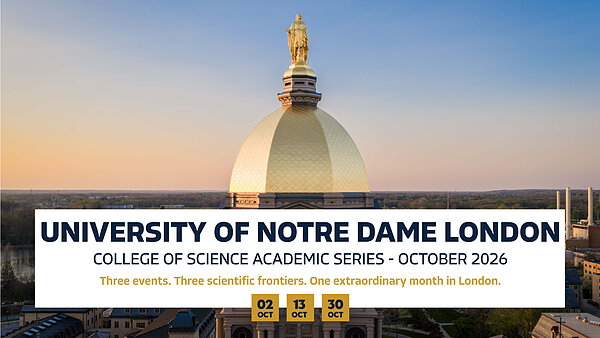
With topics from the frontiers of physics, biological sciences, and chemistry, this program, hosted by Notre Dame researchers, seeks to expand the University's scholarly conversations to a global audience. Each event brings together researchers from the United Kingdom, Europe, and the United States and is intended to stimulate intellectual exchange, introduce Notre Dame research to new audiences, and create opportunities for future transatlantic collaboration.
The sessions, located in Marian Kennedy Fischer Hall at the Notre Dame London Campus, are as follows:
October 2, 2026:
The opening event, Mind the Gap: Bridging the Architecture of Brains and Machines, is chaired by Notre Dame Professor of Physics & Astronomy Zoltan Toroczkai. This one-day symposium explores the future of biologically-inspired computation and how it informs the design of artificial intelligence. The conference will showcase scholars from the University of Notre Dame, Oxford, King’s College London, ETH Zurich, University of Lyon, and more.
October 13, 2026:
Notre Dame Associate Professor of Biology Giles Duffield will present a lecture entitled Circadian and Photo-Biology of Disease Mosquitoes. This public event will investigate the intersection of biological clocks, light, mosquito biology, and disease. Duffield will discuss how the physiology and behavior of disease-vector mosquitoes is impacted by light-driven systems.
October 30, 2026:
The final event is chaired by Shahriar Mobashery, Navari Family Professor in Life Sciences in the Department of Chemistry and Biochemistry. The symposium, Antibiotics and Antibiotic Resistance, explores the global phenomenon of antibiotic resistance. The discussion will also cover the nature and mechanisms of antibiotics considered in light of the development of new therapeutics. The keynote will be delivered by Christopher Schofield of the University of Oxford, and will showcase lectures by experts from France, Germany, the Netherlands, the U.K., and the U.S..
All events are free to attend, but advanced registration for each individual event is required.
Originally published by Max Gerd at science.nd.edu on September 10, 2026.
]]>
Max Gerdtag:neuroscienceandbehavior.nd.edu,2005:News/1852432026-09-02T10:41:00-04:002026-09-02T10:41:02-04:00Let’s walk: Meeting the moment in mental health
What does it look like to meet a community where it is? In this episode, we walk alongside those working to better understand—and respond to—the growing mental health needs across our region, including the role of Notre Dame’s new Wilma and Peter Veldman Family Psychology Clinic in expanding access to care.
Join Amanda Zelechoski, clinical professor of psychology at Notre Dame, as she walks with a mental health community partner, Lisa Kelly from Mental Health Awareness Michiana. Together, they explore the current state of mental health in Indiana—and how new partnerships, including the Veldman Clinic, are helping meet that moment.
Later in the episode, the conversation continues on campus, where two local teens share their own experiences and perspectives on youth mental health. Their voices offer an honest look at what young people are facing today—and what support could look like moving forward.
The Veldman Family Psychology Clinic combines clinical excellence, cutting-edge research, and specialized student and professional training to expand mental health access across the community. Driven by a mission to integrate science and service, the clinic delivers high-quality, low-cost, evidence-based care tailored to individuals and families, especially those in underserved populations. Community members interested in receiving clinical services or participating in ongoing research projects can visit the website for more information.
This episode of The Link was edited by Michael Wiens, with original music provided through a partnership with the Fischoff National Chamber Music Competition, and additional music provided by Universal Production Music.
The Link Podcastis available on the Public Affairs website, where episodes will be embedded alongside related stories and content.
Originally published by Colleen Wilcox, Office of Public Affairs at publicaffairs.nd.edu on August 27, 2026.
]]>
Colleen Wilcox, Office of Public Affairstag:neuroscienceandbehavior.nd.edu,2005:News/1852442026-09-02T10:41:00-04:002026-09-02T10:41:29-04:00Researchers identify key fungal genes driving urinary catheter infections
Relying on a urinary catheter is a standard part of medical care for hundreds of thousands of patients each year. Unfortunately, the device carries the risk of catheter-associated urinary infections (CAUTIs), where bacteria are widely recognized as the primary cause.
And yet, many patients face a growing threat from another pathogen: a fungus, Candida albicans.
Their work is a continuation of foundational work the research team previously published. They mapped a critical protein called Efg1, which serves as a “master switch” in C. albicans. Without this protein, the fungus cannot cause disease in a catheterized bladder. However, Flores-Mireles and Santiago-Tirado did not know which specific target genes Efg1 commanded inside a catheterized bladder.
“This protein has been really well described in other infections, but not in the bladder,” Flores-Mireles said.
The research team sequenced the genetic activity of Candida strains, identifying 75 target genes that are turned on in the bladder. Twenty-six had never been characterized before, proving how unique the bladder environment is. To verify their laboratory findings, Flores-Mireles and Santiago-Tirado, along with their doctoral student and first author, Alyssa La Bella, evaluated urinary catheters collected from patients with C. albicans by analyzing fungal RNA directly from those devices. The fungal gene network they saw in the laboratory was nearly identical to the one they detected in patient samples.
“When we got the samples from humans, and saw the exact same results, we knew this was ‘real,’” Flores-Mireles said.
Physicians often characterize fungus found on catheters as potential contamination rather than part of the active infection within the bladder, Santiago-Tirado said. This is because current diagnostic tools are designed to detect “swimming” bacteria in urine samples, rather than biofilms attached to catheters.
“For us to be able to get these catheters and show that, yes, this factor is critical, that this fungus is a colonizer, and not contamination, is important,” Flores-Mireles said. “It’s actually a virulent process.”
Their study also described how C. albicans behaves when sharing space with bacteria on a catheter. When researchers examined catheters containing both Candida and E. coli, the virulence of the Candida decreased because it is often killed by the bacteria.
“People will study these infections as monomicrobial, as like, pure infection from one pathogen,” Santiago-Tirado said. “But now we realize that in reality, in hospitals, in real life, almost all of the infections are polymicrobial, so people are starting to look more carefully at interactions between microbes and how they might have positive or negative contributions to the person’s symptoms.”
In addition to the lead team at the University of Notre Dame, collaborators contributed from the University of Guelph, Washington University School of Medicine in St. Louis, and the Leibniz Institute for Natural Product Research and Infection Biology (Hans Knöll Institute). The study was supported primarily by funding from the National Institutes of Health.
Contact: Brandi Wampler, associate director of media relations, 574-631-2632, brandiwampler@nd.edu
Originally published by Deanna Csomo Ferrell at science.nd.edu on August 27, 2026.
]]>
Deanna Csomo Ferrelltag:neuroscienceandbehavior.nd.edu,2005:News/1826442026-06-19T11:22:00-04:002026-06-19T11:22:38-04:00Psychology professors design cutting-edge intervention program for Palestinian families
Notre Dame faculty are carrying out research all around the globe, year-round. Their research spans continents, connects them with remote parts of the world, and even brings them into war and conflict-torn areas. For some of them, that’s exactly where they need to be.
For over a decade, Notre Dame psychology professors Laura Miller-Graff and Mark Cummings have been visiting Gaza and the West Bank to do transformational research. The collaboration began when Miller-Graff first began her appointment at Notre Dame in 2013 (though their connection goes back even further—Miller-Graff was an undergraduate in Cummings’ lab). They made an excellent match as collaborators due to their shared interest in the impact of political violence on children.
The resulting joint project from their partnership is Promoting Positive Family Futures—a family-based intervention program for Palestinian parents and their adolescent children to support family wellbeing, communication, and mental health in the context of the ongoing violence that Palestinians experience in their day-to-day lives. Essentially, as Cummings puts it, the program is “designed to strengthen family functioning in the face of stress.”
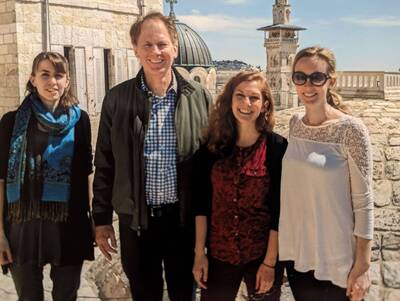
Mark Cummings and Laura Miller-Graff with two of their graduate students during a trip to Palestine.
The research has stretched over 10 years because of the thorough process behind it. Before fully launching their project, Miller-Graff and Cummings spent years carrying out a pilot program, in part supported by a Notre Dame Global grant. They then collected data from the pilot and used their findings to apply for funding to begin the next implementation phase. “We're doing something that I confidently say is world-class work. It's world-class intervention research, cutting edge,” Cummings says. They’ve found outstanding partners in Catholic Relief Services and the Palestinian Counseling Center, and eventually, secured essential funding from the National Institute of Mental Health. “It's been really a great privilege to be able to work with our partners on it and continue to fine-tune it for the families,” Miller-Graff says. This “fine-tuning” is a vital part of their process. As Cummings shares, “We really wanted to contextualize our program for the needs of Palestine.”
One lesson they learned from paying attention to the local audience was the need to reformat their working groups. “The idea was to have mothers, fathers, and children do the program in groups, and then we got our first pilot data back from 25 families,” Cummings says. “This first pilot study was conducted in the West Bank in 2017 in collaboration with the Palestinian Counseling Center. We had great participation by mothers and adolescents (in this first pilot study) but not a single father participated.” Rather than write off fathers as uninterested, they dug deeper and made changes for the second pilot study conducted in Gaza with 62 families (mothers, fathers and adolescent children) supported by Catholic Relief Services (CRS). “We had separate sessions for dads and then one for mothers and adolescents. We tried that because we concluded that it doesn't work in Palestinian culture (based on our West Bank pilot study) to have unrelated men and women together,” Cummings remarks. The outcome for the second pilot study in Gaza in 2019? Participation from fathers jumped drastically—from zero to nearly 100%, including participation in the 8 treatment sessions and pretest, post-test and 6-month follow-up assessments.
The main purpose of their most recent visit, this past year, was to meet the therapists they’d been working with to learn about their experience implementing the program. They also met with some of the families who participated in the program.
“It was really, really beautiful to meet with the families,” Miller-Graff says. “It's been interesting because there's this element of what families agree that they've gotten out of the program as a family, but also each individual member taking away different things according to what their needs were at the time. We've been really happy because it speaks to the program's ability to flexibly meet a diverse set of needs that families might bring, which was really our hope heading into it.”
Cummings speaks of the challenges they faced throughout, particularly in the beginning, as they worked to secure funding and partners. They thought they had ironed out everything and made plans to return to the West Bank and Gaza to finally implement their project. They visited colleagues at the Palestinian Counseling Center in the West Bank in the summer of 2023 but did not visit the Catholic Relief Services site in Gaza. To accomplish a follow-up visit to Gaza, they booked their flights for mid-October of 2023, days after the October 7th attack that would ignite the Israel-Hamas war.
“We had to cancel our plane tickets and close down the Gaza site because of the war,” Cummings shares. Remarkably, they were back up and running a month later, jumping on conference calls with colleagues at CRS and the Palestinian Counseling Center every week, often multiple times a week. Their original goal was to work with 150 families in the West Bank and 150 in Gaza. “After the war started, it was not tenable to continue in Gaza, our partners needed to redirect their resources to lifesaving humanitarian aid,” Miller-Graff says. By December of 2023, they had resumed work in the West Bank, sticking to their goal of serving 300 families.
“It really is a real testament to our partners. It has taken an enormous amount on all sides of careful rethinking about what providers need, how we need to do training differently, how we need to deliver the intervention to families, where we would deliver the intervention to families, to make sure that we're doing this work in a way that is physically safe for families,” Miller-Graff says.
Gabi Mitchell, Laura Miller-Graff, and Mark Cummings at Tantur.
One aspect that’s made the continuation of their project achievable, despite the challenges, is Notre Dame’s global location in Jerusalem, Tantur. “Tantur’s been central to all this since the beginning,” Cummings says. Over the years that they’ve carried out their research in the West Bank and Gaza, Miller-Graff and Cummings have used Notre Dame Jerusalem’s physical location as a home base. The location is ideal, allowing them to travel as needed between sites. Additionally, the local Notre Dame Jerusalem team has been an invaluable resource. Miller-Graff shares, “It's really meaningful for Notre Dame to have these global centers as an integrative space to allow for conversation, feedback loops, interdisciplinary research, and educational spaces.”
Notre Dame Jerusalem, and Notre Dame’s other eleven locations around the world, aim to provide just that to faculty, students, staff, and members of the Notre Dame community. For Miller-Graff and Cummings, the Notre Dame Jerusalem team and location at Tantur has not only served as a practical resource but also as a connection to the Notre Dame family while away from campus. “We've definitely felt the importance of being a part of that community,” Miller-Graff says. “Daniel [Schwake] and Gabi [Mitchell] are really instrumental in facilitating that and have been an incredible support.”
For faculty traveling far and wide to carry out work for the greater good, global locations like Notre Dame Jerusalem remind them of the support the University offers, even miles and miles from home.
While Miller-Graff and Cummings may be wrapping up their research in the next year, that doesn’t mean the work shuts down. “We're in the process of what's called sustainability,” Cummings shares. “We're systematically working with our local partners to sustain the program in the West Bank after we leave so they have the knowledge they need to run the program after we leave to set it up for future groups.” Cummings is also actively working on extending the Promoting Positive Family Futures program and adopting it for use in Ukraine, working with Ukrainian Catholic University to implement it.
Ultimately, for Miller-Graff and Cummings, the success of their work lies in its longevity. “We're really dedicated to long-term engagement with community partners,” Miller-Graff says. “Funding comes and goes, but the work is always there and needs to be done.”
Originally published by Jessie Carson at jerusalem.nd.edu on June 17, 2026.
]]>
Jessie Carsontag:neuroscienceandbehavior.nd.edu,2005:News/1819842026-05-22T10:00:29-04:002026-05-22T10:00:29-04:00College of Science Announces 2025-26 Faculty Awards
Steve Corcelli, Ph.D., William K. Warren Foundation Dean of the College of Science, has announced the college’s faculty award recipients for the 2025–26 academic year.
Father James L. Shilts, C.S.C./Doris and Gene Leonard Teaching Award
Bestowed annually on a faculty member in the College of Science, this award is named in honor of Father James L. Shilts, C.S.C., who taught in the Department of Physics from 1961 until his death in 1982. The award was endowed in 1984 by Dr. Eugene T. Leonard III in memory of his parents, Dr. Eugene and Doris Leonard. Leonard III served on the Science Advisory Council from 1976 to 1991. The award recognizes a faculty member who has demonstrated sustained excellence in teaching.
The 2026 recipient is Marya Lieberman, Nancy Dee Professor of Cancer Research.
Lieberman joined the Department of Chemistry and Biochemistry faculty in 1996 and was named the Nancy Dee Professor of Cancer Research in 2025. She has taught a broad range of courses across the chemistry and biochemistry curriculum, from introductory undergraduate classes to advanced undergraduate and graduate courses. She has also mentored numerous undergraduate and graduate student researchers.
The overarching theme of Lieberman’s career has been using chemistry to improve people’s lives. This commitment is reflected in both the courses she teaches and the mentoring relationships she builds with students. Through community-engaged courses and undergraduate research projects aimed at improving health and well-being for vulnerable communities, Lieberman embodies Notre Dame’s aspiration to educate the whole person—mind and spirit.
Lieberman is widely recognized for her contributions to education. In 2025, she received the American Chemical Society (ACS) Gustavus John Esselen Award for Chemistry in the Public Interest for her work developing paper analytical devices and training students and scientists to use them. She also received the 2022 J. Calvin Giddings Award for Excellence in Education and the 2010 Joyce Award for Excellence in Undergraduate Teaching. The 2026 James L. Shilts, C.S.C./Doris and Eugene Leonard Teaching Award further recognizes her sustained record of impactful teaching and student mentorship.
College of Science Research Award
Each year, the College of Science recognizes an outstanding investigator who has made substantial recent contributions to their field. This award honors a highly productive faculty member whose research trajectory demonstrates growing national and international impact.
The 2026 recipient is Xin Lu, John M. and Mary Jo Boler Collegiate Professor.
Lu joined the University of Notre Dame in 2017. He earned his Ph.D. in molecular biology from Princeton University in 2010. Prior to his appointment at Notre Dame, he held postdoctoral positions at the Dana-Farber Cancer Institute in Boston and the University of Texas M.D. Anderson Cancer Center in Houston. He was promoted to associate professor in 2022 and rapidly promoted to professor in 2026.
Lu is a leader in cancer immunotherapy and tumor immunology, with research focused on cancer-cell and microenvironment-driven mechanisms of immune evasion. His recent work has advanced both fundamental cancer immunology and new therapeutic strategies. Since earning tenure in 2022, Lu has published 44 papers, including original research, reviews, and editorials.
Further evidence of Lu’s research excellence can be seen in his robust funding record, which includes continuous support from the NIH and the Department of Defense, as well as several foundations, including Susan G. Komen and the Breast Cancer Alliance. His work has also been recognized through numerous honors, including the Rising Star Award from the Serican Academy of Urology in 2026 and the Coaches vs. Cancer Innovation Award from the American Cancer Society in 2025. At Notre Dame, he received the Department of Biological Sciences Faculty Excellence in Research Award.
Lu has also made significant service contributions to the scientific community. He serves as a standing member of the NIH Tumor Host Interactions Study Section and contributes to peer review as a guest editor and reviewer for numerous journals. As a Dean’s Fellow, he contributed to a review of graduate programs and student support across the College of Science. Through his research leadership, scholarly productivity, and service to the scientific community, Lu is highly deserving of the College of Science Research Award.
College of Science Outstanding Research Service Award
The College of Science Outstanding Research Service Award recognizes a scientist who has made a significant difference in supporting scientific research across the college. The award highlights a research faculty or staff member whose technical expertise, consulting, training, or guidance has meaningfully advanced the work of others.
The 2026 recipient is Evgenii Kovrigin, research professor, and director of the Magnetic Resonance Research Center.
Kovrigin joined the University of Notre Dame in 2018. He earned his Ph.D. in chemistry from the Engelhardt Institute of Molecular Biology in Moscow, Russia, in 1999. He held postdoctoral positions at the Institute of Protein Research in Pushchino, Russia; UT Southwestern Medical Center in Dallas; and Yale University. Prior to joining Notre Dame as a research associate professor, he served on the faculties of the Medical College of Wisconsin and Marquette University in Milwaukee. He was promoted to research professor in 2025 and serves as director of the Magnetic Resonance Research Center.
As director, Kovrigin supports eight instruments used by more than 200 researchers across the Colleges of Science and Engineering. He has also developed numerous software packages for analyzing NMR data that are used by researchers around the world.
In 2024, Kovrigin led the effort to build a custom helium storage system, the High Pressure Helium Reserve. Together with the Notre Dame Helium Recovery and Liquefaction Facility, the system helps prevent disruptions to NMR instrumentation caused by helium shortages. Beyond this work, Kovrigin hosted and co-organized the 8th Gateway NMR Conference at Notre Dame in 2023, bringing NMR spectroscopists from across the Midwest to campus. Through his technical leadership, infrastructure development, and support for researchers across disciplines, Kovrigin has made exceptional contributions to scientific research at Notre Dame.
Sister Kathleen Cannon Award for Excellence in Undergraduate Advising
This award is named in honor of Sister Kathleen Cannon, O.P., D.Min., a longtime advisor for the science collegiate sequence majors and a tireless advocate for students from all backgrounds. Sister Kathleen served as associate dean of the College of Science from 1998 to 2022 and associate provost of the university from 1990 to 1997.
The 2026 recipient is David Veselik, associate dean of undergraduate advising.
Veselik has been a tireless advocate for Notre Dame students. He advised students during the final years of the Science Business major, a program closely connected to Sister Kathleen’s work. Students who nominated Veselik praised his kindness and thoughtful, patient, and encouraging approach to advising. One student nomination captured the sentiment shared by many: “Dr. V deserves this award because he goes beyond course scheduling or degree requirements and empowers students to make decisions that reflect their actual goals.”
After serving for two years as a visiting assistant professor, Veselik joined the faculty as an assistant teaching professor in 2009 and was promoted to associate teaching professor in 2016. He began his advising career in 2013 when he became advisor and director of undergraduate studies for the Department of Biological Sciences. In recognition of his excellence in that role, he received the 2017 Dockweiler Award for Undergraduate Advising.
As associate dean for undergraduate advising in the College of Science, Veselik is known for his student-centered focus, calm and positive demeanor, sound judgment, and strong leadership. He also continues to teach in the Department of Biological Sciences and, in 2023, received a Rev. Edmund P. Joyce, C.S.C., Award for Excellence in Undergraduate Teaching.
Public Engagement in Science Award
This award recognizes a faculty member in the College of Science who has demonstrated a sustained record of excellence in public engagement by making noteworthy contributions that increase the public’s understanding of science and scientific progress. Such excellence may include innovative outreach or educational initiatives, meaningful partnerships with community groups, programs that broaden access to science, new mechanisms to engage the community with our researchers, or impactful efforts that reach audiences traditionally underserved or overlooked in STEM.
The 2026 recipient is Susan del Valle, associate teaching professor in the Department of Chemistry and Biochemistry.
Del Valle, who also serves as faculty advisor for both the Chemistry & Biochemistry Club and the Fighting Irish Science Olympiad, earned her B.A. in veterinary pharmacology from the University of Florida in 1996 and her Ph.D. in chemistry from the University of California in 2004. She completed a postdoctoral fellowship at the Université de Montréal before becoming an editorial assistant for the journal Organic Letters in 2006. After serving as an assistant professor of instruction at the University of Tampa, she joined the Notre Dame faculty in 2019.
At Notre Dame, del Valle’s mentorship and vision have enabled students to use their scientific knowledge and resources to make meaningful impacts across Northern Indiana and the Great Lakes region. Through the Chemistry & Biochemistry Club, she has organized monthly opportunities for students to volunteer, socialize, and develop career resources.
Each January, del Valle leads Notre Dame’s annual Fighting Irish Science Olympiad, which typically brings more than 200 students from 10–20 regional schools to campus to showcase their scientific knowledge. Her leadership and organization have made the event a sustained success, earning consistent praise from participants and the broader community.
Originally published by Samantha Keller at science.nd.edu on May 19, 2026.
]]>
Samantha Kellertag:neuroscienceandbehavior.nd.edu,2005:News/1819832026-05-22T09:59:00-04:002026-05-22T09:59:19-04:00Juan Del Valle Honored with 2026 Joyce AwardJuan Del Valle, W.K. Warren Family Professor and Associate Chair of the Department of Chemistry & Biochemistry, is one of three recipients of the 2026 Rev. Edmond P. Joyce, C.S.C., Award for Excellence in Teaching. This is the university’s most prestigious teaching award, acknowledging sustained excellence in the instruction of undergraduate, graduate, or professional students.
Professor Del Valle is recognized for excelling at teaching complex ideas in ways that connect with students and spur their understanding and interest. Even though his primary subject is organic chemistry for non-majors, typically one of the hardest courses on campus, students regularly comment about his dedication to creating an environment where they feel comfortable asking questions and seeking help. Students praise his relatability, his genuine concern for their success, and his impact on their future confidence in scientific endeavors. Del Valle is also recognized for his early participation in the Mary E. Galvin Science & Engineering Scholars program, being credited as a key contributor to the program’s success.
Professor Del Valle received his Ph.D. from the University of California San Diego and his B.A. from Carleton College. He joined Notre Dame in 2019 after being on the faculties at the University of South Florida and Moffitt Cancer Centers.
Originally published by Rebecca Hicks at chemistry.nd.edu on May 20, 2026.
]]>
Rebecca Hickstag:neuroscienceandbehavior.nd.edu,2005:News/1819822026-05-22T09:58:00-04:002026-05-22T09:58:41-04:00College of Science Awards Outstanding Students in the Class of 2026
Outstanding College of Science students in the Class of 2026 were honored at the Dean’s Awards Luncheon in the Jordan Hall of Science on Friday, May 15 during Commencement Weekend. Steve Corcelli, William K. Warren Foundation Dean of the College of Science, presented the following awards.
Dean’s Award Jacob Finley
Dean’s Research Award Benjamin Frostino Thomas Reimer
The College of Science department chairs presented the following awards to students in their respective departments.
Department of Applied and Computational Mathematics and Statistics
Outstanding Applied and Computational Mathematics and Statistics Major Award Thomas Clark Christine Hruby
Applied and Computational Mathematics and Statistics Research Mission Award Minseo (Iris) Choi
Applied and Computational Mathematics and Statistics Continuing Education Award Grace Organ
Department of Biological Sciences
Outstanding Biology Student Leader Award John Blount Faith Groody
Outstanding Biological Scientist Award Mia Endl
Outstanding Environmental Scientist Award Gracie Speicher
Mr. and Mrs. Frank McDonald Undergraduate Research Award Kristen Rizkalli
Mr. and Mrs. Frank McDonald Senior Leader Fellowship Ariana Yeganeh
Robert Braco, M.D. Honors Research Award Austin Dungan
Paul F. Ware, M.D. Excellence in Undergraduate Research Award Maggie Zhao
Department of Chemistry & Biochemistry
Outstanding Biochemist Award Kaitlin Ryan
Outstanding Biochemistry Research Award Jack Markillie
Outstanding Chemist Award Matthew Politte
Outstanding Chemistry Research Award Madeline Schearer
William R. Wischerath Outstanding Chemistry Major Award Thomas Reimer
Chemistry and Biochemistry Leadership Award Charlie Desnoyers
Royal Society of Chemistry Certificate of Excellence Christian Kay Zachary Koh
ACS Division of Analytical Chemistry Outstanding Senior Analytical Chemistry Student Daniel Pena Valinotti
ACS Division of Inorganic Chemistry Outstanding Senior Inorganic Chemistry Student Jack Nichols
Department of Mathematics
Senior GE Prize for Honors Majors in Mathematics Andrew Brooks Clark Wu
Senior GE Prize for Mathematics Majors Jacob Arulandu
The Kolettis Award in Mathematics Adriana Baniecki Kevin Murawski
The R. Catesby Taliaferro Prize for Best Senior Thesis Luca Nijim Peter Kilway
Department of Physics & Astronomy
Outstanding Senior Physics Major Award Braden Carroll Connor Smith
Outstanding Undergraduate Research Award Nathan Muetzel Paul Chagnon Award Rose Hewald
Preprofessional Studies
The Lawrence H. Baldinger Award Ella Johnson Richie Mistichelli Alaina Thorne
The Patrick J. Niland, M.D. Award Michael Morrissey
The Reverend Joseph L. Walter, C.S.C. Award Brady Soenen Nathaniel Sowers
Samuel J. Chmell, M.D. Award Jack Doohan
Neuroscience and Behavior Major
Outstanding Undergraduate Research Award Benjamin Frostino John Oliver
Outstanding Undergraduate Teaching Award Brody Rolston Jairo Soto Leon
Outstanding Undergraduate Leadership and Service Award Mary Jordan Julia Rea
Universal Scholar Award Nicholas Bifone
Collegiate Sequence
Collegiate Sequence Award Wolfie Erhart Timothy Theisen Michael Van Etten
The following students were recognized as the recipients of prestigious external fellowships.
Churchill Scholarship Jacob Finley
Goldwater Scholarship Jacob Finley Thomas Reimer
Marshall Scholarship Manny Uzobuife
Fulbright U.S. Student Program English Teaching Assistantship Jake Ryan
Originally published by Samantha Keller at science.nd.edu on May 20, 2026.
]]>
Samantha Kellertag:neuroscienceandbehavior.nd.edu,2005:News/1817382026-05-14T12:33:00-04:002026-05-14T12:33:33-04:00Football walk-on Jerry Rullo #46 headed to Harvard Medical School
The lights beaming down on Generoso “Jerry” Rullo ’26 felt shockingly bright at Notre Dame Stadium at the end of the Florida State game in 2024. Even though Notre Dame was ahead by more than 40 points, Rullo, a walk-on linebacker taking his position on the iconic football field for the first time, felt a twinge of fear as he faced off against a lineman.
“He looked really big in person, more than you’d think,” said Rullo. The surreal scene briefly reminded him of controlling a player in an EA Sports’ Madden NFL video game.
“I kind of instinctively tuned it out,” he said, thinking back to his training. “Once your instincts kick in, you know, you go where you need to go.”
Originally published by Deanna Csomo Ferrell at science.nd.edu on May 12, 2026.
]]>
Deanna Csomo Ferrelltag:neuroscienceandbehavior.nd.edu,2005:News/1816962026-05-13T10:45:00-04:002026-05-13T10:45:49-04:00Psychology major Lizbeth Cordova Lopez ’26 finds ‘a sense of hope for the future’
When Lizbeth Cordova Lopez looked over a list of colleges from her high school counselor, a crooked stroke of a highlighter drew her attention to one school: the University of Notre Dame.
At the time, Cordova Lopez, who is from Sylmar, California, thought she would go to nearby UCLA. But her counselor had encouraged her to consider colleges outside her home state as well and highlighted various schools.
“I don’t know if her marker ran out or if the paper shifted, but the highlighting was jagged,” she said. “And, I just impulsively thought, ‘Oh, I’ll apply to that school — maybe there’s a reason this one stands out from the rest.’”
That one stray mark became the start of Cordova Lopez’s Notre Dame journey.
As Cordova Lopez learned more about the University, she was drawn to its Catholic identity and values — but it was her first visit to campus for admitted students day that helped her finalize the decision.
“Stepping onto this campus for the first time was the most magical feeling,” she said. “Everyone was so welcoming, and everyone we met was doing such incredible things. After you experience Notre Dame, it’s hard to go back because it shows you there’s so much more.”
That fall, she and 12 members of her family — grandparents, aunts, uncles and cousins — drove in two cars from Southern California to campus to help her move in.
Four years later, her family will return, even larger in number, to cheer her on at Commencement.
Cordova Lopez, a psychology major with a supplemental major in education, schooling and society, has made the most of those four years. But now, as a mentor to first-year students at Notre Dame through the Building Bridges program, she has one key piece of advice for them: Trust that the things you’re passionate about will lead you somewhere meaningful.
“Once you start doing that, it opens doors that you can’t even imagine,” she said. “So, take the classes that seem interesting, follow your passions and then build from there.”
For Cordova Lopez, that meant starting from a personal experience that shaped her childhood: When she was 3 years old, her father was incarcerated and spent the next 13 years in prison.
“I wanted to understand more about how the system works and why — as well as what happens to the children of those who are incarcerated,” she said. “Those children are at a much higher risk of dropping out of school and are much less likely to attend college. And that’s something I’d like to change.”
Cordova Lopez was one of five Notre Dame students who presented their senior research at an undergraduate research conference at Florida State University.
Cordova Lopez, a first-generation college student and AnBryce Scholar, began researching incarceration the summer after her first year, as she worked with women in a correctional facility in Ohio and in transitional housing. The internship, offered by the University’s Institute for Social Concerns, allowed her to gain hands-on experience in reentry programming and inspired her to delve deeper.
Her research experiences culminated in a senior thesis project this year on the joint impact of parental and school involvement on children’s academic resilience, particularly in the context of economic hardship.
The summer after her junior year, Cordova Lopez studied abroad in South Africa, where she explored themes of apartheid and othering, and in China, examining the philosophy of science.
She has also been deeply involved in the local community, working with children in South Bend schools through the Tutor-ND program, volunteering at the Robinson Community Learning Center and engaging with Campus Ministry’s Mercy Works. Her involvement began at Dismas House — a home for those in transition after prison — and has since grown into a role as an anchor intern, where she helps lead orientations that send students to service sites across the community.
After graduation, she will attend Stanford University to complete a master’s in policy, organization and leadership studies, through their graduate school of education, before pursuing a graduate program in clinical psychology.
“My goals in life are to start a nonprofit focused on children of incarcerated parents to help them gain access to equitable education and to help children navigate trauma and adversity,” she said. “Having one less parent always leaves some type of void, but I was lucky enough to have a lot of extra support from my family, and that helped so much. I want to focus my career on helping children who may not have that support system.”
The Notre Dame community has not only prepared her to reach those goals, she said, but — more importantly — has become a second family to her along the way.
“Notre Dame does a beautiful job of just being there for one another,” she said. “I’ve felt this overwhelming sense of love and support from everyone here from the beginning. And now, I want to take that feeling with me and help spread it wherever I go.
“Notre Dame has given me a sense of hope for my future — and for the future of the children I hope to serve someday.”
Originally published by Carrie Gates at news.nd.edu on May 11, 2026.
“This year’s faculty award recipients represent the very best of Notre Dame through their outstanding achievements in teaching, scholarship, and service,” McGreevy said. “Their work strengthens our academic community and furthers the University’s mission as a leading global Catholic research institution.”
The 2026 University faculty award winners are:
Rev. Edmund P. Joyce, C.S.C., Awards for Excellence in Teaching: Badih Assaf (Department of Physics and Astronomy), Juan Del Valle (Department ofChemistry & Biochemistry), and Roya Ghiaseddin (Department of Applied and Computational Mathematics and Statistics)
Research Achievement Award: Peter Garnavich (Department of Physics and Astronomy), Eric Jumper (Department of Aerospace and Mechanical Engineering), and Jennifer Tank (Department of Biological Sciences)
President's Award: Ernest Davis Morrell (Departments of English and Africana Studies)
Hesburgh Legacy Award: Gerard F. Powers (Kroc Institute for International Peace Studies)
Dockweiler Awards for Excellence in Advising: Maria Holland (Department of Aerospace and Mechanical Engineering), Karen Richman (Institute for Latino Studies), and Gina V. Shropshire (Mendoza College of Business)
Faculty Award: Christopher Kolda (Department of Physics and Astronomy)
Rev. Paul J. Foik, C.S.C., Award: Mark Robison (Hesburgh Libraries)
Thomas P. Madden Award: Giuseppe Mazzone (School of Architecture)
Coordinated by the Office of the Provost, the annual University faculty awards recognize excellence in research, teaching, and service to the University; signal milestone accomplishments and contributions across the disciplines; and celebrate outstanding members of the Notre Dame community.
Learn more about the awards and read the citations for this year's winners at provost.nd.edu/awards.
Originally published by Emily Monacelli Guzman at provost.nd.edu on May 12, 2026.
]]>
Emily Monacelli Guzmantag:neuroscienceandbehavior.nd.edu,2005:News/1815582026-05-08T11:53:00-04:002026-05-08T11:53:43-04:00Department of Chemistry & Biochemistry Among 2026 Canvas Legends Award Winners
Notre Dame uses the Canvas learning management system (LMS) as its online platform for instructors to provide learning materials and activities that supplement face-to-face, blended, or fully online academic courses. That means when Notre Dame students go to access their course materials online, it’s highly likely their instructor is sharing them through Canvas.
The Canvas Legends Awards place the spotlight on faculty turning that seemingly routine task into an art.
“Hearing how our faculty are using Canvas to impact student learning from the perspective of the students themselves is nothing short of awesome,” said Steve Varela, director of the Office of Information Technology’s Teaching & Learning Technologies (TLT) team, which sponsors the awards. “Reading their nominations of their professors brings to life the types of best practices we share to help both students and faculty get the most out of their Canvas experience.”
Exceptional use of Canvas and/or its integrated tools can take any number of forms, and students are invited to submit nominations for reasons such as:
The course is designed with student learning objectives in mind.
Resources and workflow are built with an eye toward accessibility, from the beginning.
The instructor uses Canvas to communicate frequently, give timely feedback on assignments, and/or otherwise keep students engaged with the course.
The course, simply put, looks amazing.
From the nominations received, the TLT team selects instructors whose use of Canvas best exemplifies a Canvas Legend.
Among other honors, this year’s recipients—as well as the winner of TLT’s inaugural Teaching with Technology Impact Award—will be celebrated during a campus recognition event on Thursday, April 30.
2025–26 Canvas Legends
The TLT team is pleased to announce the 2025–26 Canvas Legends.
Department-Level Award
In addition to recognizing instructors, the TLT team felt the volume and breadth of nominations called for something more: a department-level Canvas Legends Award.
Department of Chemistry & Biochemistry Canvas Legends. Row 1, left to right: Saurja DasGupta, Dana Horgen, and Dana Lashley. Row 2: Brittany Morgan, Bradley Smith, and Sarah West.
Instructor-Level Awards
Josephine Akosa Assistant Teaching Professor, Department of IT, Analytics, and Operations
From the Students: “Dr. Akosa transforms Canvas into a true learning space. Everything is clear, organized, and easy to follow. Her weekly notes, videos, and interactive assignments make the course feel alive and supportive.”
“She uses Canvas with so much care and intention that it genuinely elevates the entire class experience.”
Lisa Farmer Associate Teaching Professor, Department of Biological Sciences
From the Students: “Every week is so organized, fun to use, and never confusing. There are GIFs, it is well-organized, and very fun to navigate and look at. Every professor should use her Canvas page as reference!”
Ashley Henry Program Director for Graduate Student and Postdoctoral Development, Kaneb Center for Teaching Excellence
From the Students: “Prof. Henry uses Canvas perfectly. All the in-class slides and other resources are organized in the modules folder in a way that is not overwhelming. The slides end with a class debrief and are all very engaging and creative. At the end of every class, she tells us the homework for the next class and posts homework assignments so as not to overwhelm students. I could not speak more highly.”
Erin McLaughlin Teaching Professor, University Writing Program
From the Students: “She is so organized and skilled in Canvas! I am never lost and know everything I need to do to be successful.”
Joshua Seachris Associate Teaching Professor, Department of Philosophy
From the Students: “Out of all my professors, his course is the most organized and usable for students.”
“The course is the most visually beautiful Canvas page I’ve seen in my five semesters, the most accessible for people with disabilities, and the most clearly defined/merit-based course I’ve seen.”
Jing Wang Associate Teaching Professor, Department of Aerospace and Mechanical Engineering
From the Students: “She has tremendous organization, with weekly sections. It is incredibly easy to navigate, to find what is due each day and what is required before each class.”
“It's very well-organized and thought-out. The clarity of instructions/tasks makes this class unique.”
Inaugural Teaching with Technology Impact Award
As part of this year’s Canvas Legends celebration, the TLT team will also honor the first recipient of its new Teaching with Technology Impact Award.
Elena Mangione-Lora Senior Teaching Professor of Spanish Language and Culture, Department of Romance Languages and Literatures
This award recognizes faculty who go beyond the tools themselves to use academic technology with intention, empathy, and an unwavering commitment to student-centered learning. Recipients will be selected based not only on what happens inside their Canvas courses, but also on how their philosophy shapes their classroom practice, their course design, and their engagement with the broader University community.
About Teaching & Learning Technologies (TLT)
Housed in the OIT and working hand-in-hand with Notre Dame Learning, the TLT team specializes in a range of areas related to teaching with technology, including learning management systems, academic software, learning spaces, learning analytics, and emerging technologies. This marked the third year of TLT’s Canvas Legends Awards.
Originally published by Laura Cira at learning.nd.edu on April 27, 2026.
]]>
Laura Ciratag:neuroscienceandbehavior.nd.edu,2005:News/1815502026-05-08T11:18:00-04:002026-05-08T11:18:08-04:00Veldman Family Psychology Clinic shapes the future of mental healthConstruction proceeds on the southern wall of the Veldman Clinic. (Photo by Jon L. Hendricks/University of Notre Dame)
Bike south along the Link Trail, take a Transpo bus along Route 7, or drive a block past Rocco’s restaurant on South Bend Avenue, and you’ll find a building that’s more than bricks and siding. It’s the region’s newest mental health ally.
Workers prepare an MRI machine for installation in the basement of the Veldman Clinic. (Photo by Jon L. Hendricks/University of Notre Dame)
With three levels and 35,000 square feet of therapy rooms, labs, childcare spaces, and more, the Veldman Clinic is a grand undertaking that, through the thought and passion put into its design, feels less like a facility and more like a home.
“On campus, we tend toward these very formal buildings that are beautiful, but what we needed is a beautiful fit for the community, where people can feel comfortable,” said Jennifer Burke Lefever, the clinic’s managing director. The clinic’s goal is to meet people where they are, and that starts before they even enter the building. Its position in the East Bank neighborhood makes the clinic a gateway to downtown South Bend, easily reached by bike, foot, bus, or car.
After passing through an accessible entrance, community members are welcomed into a lobby filled with natural light and comfy furniture. On the two-story entrance wall, there’s a large array of butterflies made from hand-painted silk scarves, designed by women at the St. Margaret’s House day center. The butterflies represent transformation, and the artwork’s curve mimics that of the St. Joseph River, as seen in the South Bend flag and the Veldman Clinic’s logo.
Beyond the lobby, design choices both distinct and subtle aim to reduce stress. Artwork across from the elevators uses patterns invoking the art of kintsugi, a Japanese pottery practice of repairing cracks with gold — a reminder that healing can create something stronger and more beautiful than before. A wall in the children’s room is covered with a nature scene made from soft felt. Wide hallways with tall ceilings reduce feelings of claustrophobia, with windows at the end of every corridor aiding visual orientation. And everything from furniture to drinking fountains was selected with wheelchair users in mind.
Construction progresses at the Veldman Clinic. (Photo by Michael Caterina/University of Notre Dame)
The clinic’s design also incorporates innovative technologies being introduced to the University for the first time. The Human Neuroimaging Center — led by Aron Barbey, the Andrew J. McKenna Family Professor of Psychology — will house an MRI machine capable of producing structural, functional, and metabolic brain imaging, driving ambitious neuroscience research. The building’s 40 therapy rooms will use a new VALT video system to securely record therapy sessions led by clinical psychology graduate students, so supervisors will be able to review sessions on demand.
“One of our studies will use every floor of the Veldman Clinic,” said Kaylin Hill, an assistant professor of psychology.
Hill’s research focuses on understanding reward and emotion and how they relate to clinical disorders like major depression. She often uses psychophysiological tools, such as an electroencephalogram (EEG), which tracks brain signals through electrodes placed on the scalp. The Veldman Clinic’s EEG setups and interview rooms will help her conduct research outside of her lab in Corbett Family Hall, which is less accessible for the families she works with.
The long-held dream of a psychology clinic finally became a reality through support from leadership at Notre Dame and the College of Arts & Letters, as well as the generosity of multiple Veldman family foundations, including those of Sharon and Matt Edmonds, Connie and Mike Joines, and Anita and Tom Veldman. But Burke Lefever and Kristin Valentino, the clinic’s director and a professor of psychology, knew it wouldn’t be successful without significant input from community partners who have long worked in the area.
Those partners include Oaklawn, a provider of mental health services and addiction treatment; Beacon Community Impact, the public health arm of Beacon Health Systems; and the CASIE Center, which works to prevent child abuse and support survivors. All three are located within blocks of the Veldman Clinic.
Aron Barbey, the Andrew J. McKenna Family Professor of Psychology, meets with Nathan Muncy, an assistant research professor in the Department of Psychology. Barbey leads the Human Neuroimaging Center, which will soon be housed in the Veldman Clinic. (Photo by Jon L. Hendricks/University of Notre Dame)
“We have a role to play within the system that is already in place, so we need close collaboration with community partners to ensure we are adding value and addressing needs rather than recreating something that already exists,” Valentino said.
A strong internal team of about 20 staff across the Veldman Clinic, Shaw Center, and Human Neuroimaging Center are essential to supporting the research of faculty and graduate students and the services they provide.
Staff clinicians, including a licensed clinical social worker, are joining the clinic to expand the amount and types of care the University can provide. In the past, the Notre Dame Department of Psychology has only offered clinical services provided by graduate students who are training to become psychologists and are supervised by faculty.
With licensed clinicians adding to the students’ work, the number of clinical care and impact hours annually provided by Notre Dame is projected to increase from 8,000 to 27,000. The clinic’s impact will be even wider as graduate students earn their doctorates and start their own practices, and as evidence-based interventions developed through research are implemented in community settings throughout the region and across the country.
Every person working at the clinic has a role to play in fulfilling the clinic’s mission. The administrative coordinator, who welcomes visitors at the front desk, is trained in de-escalation tactics, ready to be a mental health crisis first responder. Data managers, community liaisons, the Office of Information Technology, facilities teams, research assistants, and other professionals will also contribute to the clinic’s work, adding to the countless hours already put in by architects, designers, and project managers.
“It definitely takes a team across the entire campus to make it all happen,” said Heidi Miller, assistant director for staff management and operations at the clinic. “We all believe in what we’re doing, and that’s what makes it work.”
Originally published by Adah McMillan at ndworks.nd.edu on May 04, 2026.
]]>
Adah McMillantag:neuroscienceandbehavior.nd.edu,2005:News/1815492026-05-08T11:15:00-04:002026-05-08T11:15:29-04:002026 College of Science faculty promotions and retirements
Congratulations to College of Science faculty who have earned promotions in 2026 in recognition of their outstanding teaching, research, and service, as well as those who have been granted emeritus status.
Originally published by Samantha Keller at science.nd.edu on May 07, 2026.
]]>
Samantha Kellertag:neuroscienceandbehavior.nd.edu,2005:News/1807122026-04-10T09:33:00-04:002026-04-10T09:33:39-04:00Notre Dame launches Human Neuroimaging Center to advance interdisciplinary neuroscience and insight into the human mindAron Barbey, the Andrew J. McKenna Family Professor of Psychology, discusses research with Nathan Muncy, assistant research professor in the Department of Psychology. (Photo by Jon L. Hendricks/University of Notre Dame)
With a significant new investment, the University of Notre Dame’s College of Arts & Letters is launching the Human Neuroimaging Center to drive innovation in interdisciplinary neuroscience and uncover how brain networks shape the remarkable capacities of the human mind.
The center’s work explores enduring questions in the psychological and brain sciences, including how the biological foundations of the mind enable learning, resilience, and flourishing — capacities central to the fullness of human life.
Led by Aron Barbey, the Andrew J. McKenna Family Professor of Psychology, who joined the Notre Dame faculty last fall, the center advances an integrated vision of modern neuroscience grounded in scientific rigor, humanistic insight, and ethical responsibility.
Workers prepare a freshly delivered MRI system for installation in the Human Neuroimaging Center in the basement of the Veldman Family Psychology Clinic at 501 N. Hill Street in South Bend. (Photo by Jon Hendricks/University of Notre Dame)
“Neuroscience opens new ways of understanding the human mind and the lives it shapes,” Barbey said. “Advances in brain imaging now allow us to see the brain with remarkable precision, revealing the constellation of networks that underlie perception, memory, language, and thought. Once uncovered, insights from neuroscience move beyond the laboratory, shaping how learning is defined, how mental illness is understood, and how responsibility and care are imagined.”
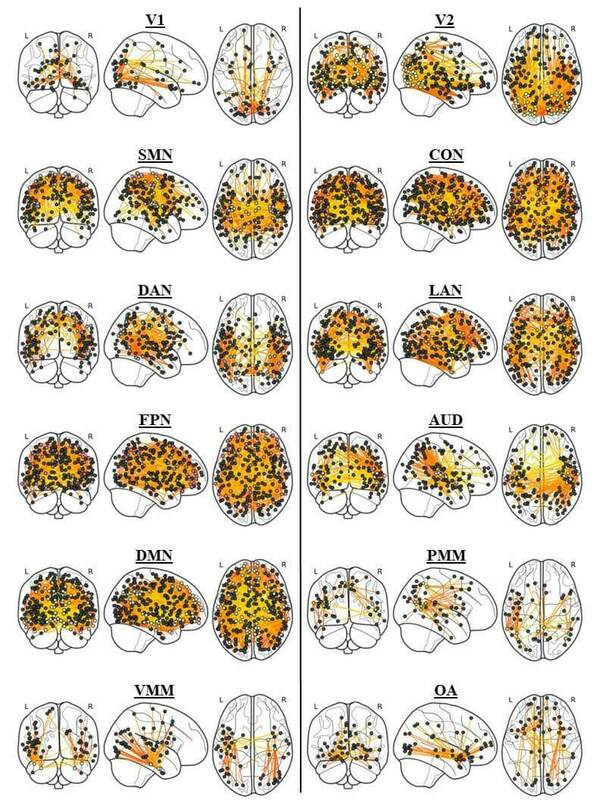
Barbey and his research team will utilize advanced neuroimaging techniques — including high-resolution functional and structural MRI, diffusion tensor imaging, and computational modeling — to investigate the foundations of human intelligence.
He joined Notre Dame’s Department of Psychology after faculty appointments at the University of Illinois at Urbana-Champaign and the University of Nebraska-Lincoln. At Illinois, he held multiple leadership roles at the Beckman Institute, including director of the Center for Brain Plasticity. He later served as the Mildred Francis Thompson Professor and director of the Center for Brain, Biology, and Behavior at Nebraska.
His previous research — supported by more than $30 million in funding from the National Institutes of Health, the National Science Foundation, the Defense Advanced Research Projects Agency, and several other organizations — has explored how intelligence emerges from the network organization and dynamics of the human connectome, applying methods from cognitive neuroscience, experimental psychology, and computer science.
“At Notre Dame, I believe we have a remarkable opportunity to lead in neuroscience because of the breadth of expertise on our campus — not only in psychology, and increasingly in neuroscience, but also in the humanities and social sciences.” – Aron Barbey, Andrew J. McKenna Family Professor of Psychology
Ultimately, his work aims to deepen understanding of the neural foundations of intelligence and to advance innovations in cognitive enhancement, neurorehabilitation, and biologically inspired artificial intelligence. Barbey’s research investigates how the brain’s finite architecture gives rise to the flexibility of human intelligence — our capacity to learn, adapt, and solve the diverse problems we face in life.
The Human Neuroimaging Center, co-located with the Veldman Family Psychology Clinic at 501 N. Hill Street in South Bend, will support a growing group of Notre Dame human neuroscience faculty, including three junior faculty who will arrive this fall, with more new hires planned for the coming years.
Barbey, his team, and other neuroscientists will use a state-of-the-art Siemens Magnetom Cima.X 3 Tesla whole-body MRI system to produce structural, functional, and metabolic brain imaging, enabling characterization of the human connectome with remarkable precision.
“Neuroscience offers a profound new lens through which we can view the human experience — one that enriches our existing strengths in the humanities, arts, and social sciences, offering new ways of developing deep insights about how we think, feel, and interact,” said Kenneth Scheve, the I.A. O’Shaughnessy Dean of the College of Arts & Letters. “At the same time, this center will help us build meaningful scientific collaborations across campus in a way that establishes Notre Dame as a leader in the holistic study of the human mind.”
The center is organized around seven research themes that investigate how brain networks support the capacities that shape human life — and how this knowledge can be used with care and responsibility:
Neuroscience of human intelligence — How do differences in the organization and dynamics of the human connectome shape memory, attention, reasoning, and problem solving?
Neuroscience of lifespan development — How does connectivity evolve from childhood through adulthood, and how do experiences — including education and embodied practices such as handwriting — influence developmental trajectories?
Neuroscience of belief systems — How do executive, social, and affective brain networks support belief systems and moral decision making, including participation in social, ethical, and religious practices?
Neuroscience of mental health — How do changes in brain network function contribute to mental health and neurodevelopmental conditions, and how can insights into these changes advance diagnosis and new approaches to treatment?
Neuroscience of traumatic brain injury (TBI) — How does TBI disrupt and reorganize the network architecture of the human connectome, and how can neuroimaging guide better diagnosis and treatment protocols in student-athlete and military populations?
Neuroscience of human performance in military service — How do multiple dimensions of performance — across cognitive, physical, and neurobiological measures — change over the course of military service, and how can long-term measurement help strengthen readiness while supporting the health and resilience of service members?
Neuroscience of brain health promotion — How can modern scientific interventions — including cognitive training, non-invasive brain stimulation, mindfulness meditation, physical activity, and nutrition — shape brain connectivity to promote brain health and resilience across the lifespan?
The Human Neuroimaging Center's new Siemens Magnetom Cima.X 3 Tesla whole-body MRI system in the Human Neuroimaging Center in the basement of the Veldman Family Psychology Clinic. (Photo by Jon L. Hendricks/University of Notre Dame)
“The mission of our neuroimaging center is to advance neuroscience through rigorous research that is attentive to the broader human questions that inspire it,” Barbey said, “seeking not only to understand the complex and dynamic networks of the human brain, but also to ensure this knowledge benefits the individuals and the communities that we serve.”
Through these themes, Barbey sees ways for neuroscience to engage directly with broader questions of human development, belief, health, performance, and responsibility — ensuring that scientific advances are interpreted in light of history, culture, and enduring questions of human meaning.
“At Notre Dame, I believe we have a remarkable opportunity to lead in neuroscience because of the breadth of expertise on our campus — not only in psychology, and increasingly in neuroscience, but also in the humanities and social sciences,” he said. “The brain is more than a biological system; it underlies how we think, learn, and relate to one another. Its activity is shaped by biology and experience — including culture, history, family, and community. For that reason, neuroscience matters not only for what it reveals about the brain, but for how its insights enrich learning, promote health, and enable flourishing — in service of human dignity and the good we share.”
Originally published by Arts & Letters at al.nd.edu on April 02, 2026.
]]>
Arts & Letterstag:neuroscienceandbehavior.nd.edu,2005:News/1807102026-04-10T09:29:00-04:002026-04-10T09:29:46-04:00Notre Dame Team Secures First-Ever Victory at Emory Morningside Global Health Case Competition
The University of Notre Dame team took top honors at the recent international Emory Morningside Global Health Case Competition. This year, the highly competitive annual competition included 31 teams from universities across the US and around the globe. This is the first time a Notre Dame team has won this competition since annual participation began in 2016. An honorable mention was earned in 2021.
The winning Notre Dame global health case competition team was made up of undergraduate students and included:
In addition, Olivia Cai, '28, Finance and Philosophy, assisted the team in the competition's first round.
“At the Emory competition, there was a wide range of participants involved,” said Matara. “Seeing teams from schools and medical schools across the United States, in addition to schools in Canada, Australia, Uganda, and Malaysia, was truly inspiring. It was amazing to see how many people around the world share a passion and interest in global health.”
The Emory University event format consists of two rounds. The competing teams receive the case about one week in advance. In round one, all teams present their solutions to the case. The top five teams are then selected to move on to round two, where they are given a new variable in the case to apply to their prepared strategy. Then the final five teams present how they would address this new variable, and judges deliberate to determine the top solution. This year, the entire event was held virtually.
The case addressed by all teams competing at Emory was titled "Beyond Calories: Rethinking Food Aid in Crisis," and it was set in the fictional country of “Kifaru.” Each team was tasked with developing a humanitarian nutrition intervention spanning a five-year period, focusing on reducing reliance on ultra-processed foods and addressing the significant burden of malnutrition. The Notre Dame team was judged to have successfully addressed all issues.
“The most challenging aspect of this year’s case was that it wasn’t based on a specific country,” said McDonald. “This forced us to have a more general and less specific proposal, but we worked to address this by drawing comparisons to real-world countries.”
“While this was initially challenging, we ultimately found a silver lining in that it allowed us to spend more time focusing on the core issues of the case itself rather than getting caught up in contextual details,” added Matara.
“Another difficult aspect was limiting ourselves to a plan that was feasible and realistic,” said LeSieur. “In the realm of global health, there is a lot of room for innovation. But an innovation has to be balanced with cultural understanding, budget constraints, and other circumstances unique to the location where the intervention is based.”
She added, “And with twelve minutes to present, it was difficult to address everything we wanted to include.”
Marian Botchway, Ph.D.
“The stellar performance of these undergraduate students, their hard work over the past several weeks, and their unwavering commitment to global health have been inspiring,” said Marian Botchway, assistant director of the Eck Institute for Global Health and faculty mentor for the team. “I am so proud of these thoughtful and passionate students.”
The road to victory began in February with the Notre Dame Global Health Case Competition, where 12 multidisciplinary student teams competed to become Notre Dame’s representative for the Emory competition. At this February contest, Victoria Gibek (‘28, Science Preprofessional Studies and Global Affairs) was also a member of the winning team. However, due to a schedule conflict, she was unable to participate in Emory’s competition.
The annual Notre Dame event and participation in the Emory event are organized by the Eck Institute for Global Health under Botchway’s leadership. While some teams for the Notre Dame competition form themselves, and she assembles others from individual registrants, all teams must include four to six students from at least three different colleges or schools to integrate multidisciplinary teamwork and perspectives in addressing global health challenges.
LeSieur noted, “I recommend joining a random team for the first year. The best solutions come from collaboration between people from different educational and personal backgrounds.”
“As a finance major, I felt that I was able to provide recommendations and solutions from a different angle and perspective, aiding in the success of the team,” said Cai.
“Last year, Ivy [Clark] and I were part of the team that advanced to the Emory competition,” added McDonald. “After participating in that competition, we saw what it took to be successful, and the two of us had a strong feeling that if we were able to come back next year, we could be very competitive.” McDonald and Clark joined forces with LeSieur and Matara, also finalists at Notre Dame’s competition in 2025.
“This is my fourth year competing in the Notre Dame Global Health Case Competition and my second year competing in the Emory event,” said Clark. “My favorite part of this is the ability to apply concepts we have learned about in coursework to real-life scenarios in new and innovative ways.”
She continued, “Three of our five team members are pursuing a Minor in Global Health, and most of us came with a lot of background knowledge from various classes and extracurriculars. Being able to combine that knowledge to come up with a novel approach to a global health issue is so rewarding.“
To learn more about education opportunities in global health, please visit the Eck Institute for Global Health website: https://globalhealth.nd.edu/education/
Contact: Damienne Jugovic, Research Communications Specialist Notre Dame Research / University of Notre Dame djugovic@nd.edu research.nd.edu / @UNDResearch
About the Eck Institute for Global Health The Eck Institute for Global Health, an integral part of Notre Dame Research, builds on the University’s historical strength in infectious disease research, including vector-borne diseases, while broadening the interdisciplinary expertise into other key global health areas including non-communicable diseases; maternal, newborn, and child health (MNCH); and global health security. The Eck Institute recognizes health as a fundamental human right and promotes research, training, and service to advance health standards and reduce health disparities, especially for those who are disproportionately impacted by preventable diseases. The Eck Institute is training the next generation of global health researchers and leaders through undergraduate, masters, doctoral, and postdoctoral programs.
Originally published by Damienne Jugovic at globalhealth.nd.edu on April 08, 2026.
]]>
Damienne Jugovictag:neuroscienceandbehavior.nd.edu,2005:News/1802702026-03-25T08:31:00-04:002026-03-25T08:31:51-04:00Steven Corcelli named William K. Warren Foundation Dean of the College of ScienceSteven A. Corcelli, professor of chemistry and biochemistry at the University of Notre Dame, has been appointed the William K. Warren Foundation Dean of the College of Science by University President Rev. Robert A. Dowd, C.S.C., effective April 1.
Corcelli, who has served as interim science dean since July, was selected through a comprehensive national search launched after his predecessor, Santiago Schnell, was appointed as Dartmouth’s provost.
“In multiple roles at Notre Dame, including associate dean, department chair, and most recently as interim dean, Steve has consistently earned the respect of his colleagues and proven to be a wise and visionary leader who is deeply dedicated to our Catholic mission,” Father Dowd said. “I am confident that under his leadership, the College of Science will continue to play an essential role in Notre Dame’s pursuit of excellence as a global Catholic research university.”
As dean, Corcelli will lead six departments comprising more than 280 faculty, more than 600 doctoral students, and 1,726 undergraduate student majors. He will guide the college in its mission to prepare the scientific leaders of tomorrow, seek greater understanding of the natural world and foster discoveries that answer the world’s toughest questions and solve its most enduring problems.
John T. McGreevy, the Charles and Jill Fischer Provost, said Corcelli rose to the top of a highly qualified pool of candidates. “Over the past two decades at Notre Dame, he has shown a commitment to collaboration and innovation in the laboratory and the classroom,” McGreevy said. “Steve’s leadership experience, his background as a first-generation college student, his distinction as a nationally recognized computational chemist and his commitment to the University’s Catholic mission will make him a superb dean of the College of Science.”
Corcelli leads a research program focused on the molecular-level understanding of aqueous acids, bases and salts, as well as on the mechanisms of biomolecular binding. His lab uses advanced simulations to investigate ion transport in aqueous electrolytes — relevant to battery technologies — and the binding interactions critical to biological function and drug development.
He has received national recognition for his research, including an NSF CAREER Award, a Sloan Research Fellowship, and the Camille and Henry Dreyfus New Faculty Award. Corcelli is a fellow of the American Chemical Society and a Kavli Fellow of the National Academy of Sciences. He has authored over 90 publications and given more than 100 invited talks.
He earned his bachelor’s degree in chemistry from Brown University and his doctoral degree in chemistry from Yale University. After completing a postdoctoral research position at the University of Wisconsin-Madison, he joined Notre Dame’s faculty as an assistant professor in 2005.
Prior to his appointment as interim dean, Corcelli served as chair of the Department of Chemistry & Biochemistry from 2022 to 2025, and as the associate dean for interdisciplinary studies and faculty development in the College of Science from 2019 to 2022.
“I am deeply honored to serve as the William K. Warren Foundation Dean of the College of Science,” Corcelli said. “Notre Dame has a unique opportunity to integrate scientific discovery with its Catholic mission in ways that serve both the University and the broader world. I look forward to working with our community to strengthen partnerships across the University and beyond; support our faculty, students and staff in their pursuit of discovery and learning; and advance an intellectually ambitious vision for science in service to the common good.”
McGreevy thanked the search committee for its work over the past several months. “Members represented the University well and were diligent in identifying, evaluating and recruiting an excellent pool of candidates,” he said. “I appreciate their steady work and discernment throughout the search process.”
Contact: Brandi Wampler, associate director of media relations, brandiwampler@nd.edu, 574-631-2632
Originally published by Kate Garry at news.nd.edu on March 24, 2026.
]]>
Kate Garrytag:neuroscienceandbehavior.nd.edu,2005:News/1794212026-02-20T16:41:00-05:002026-02-20T16:48:34-05:00Building Community Resilience at the 2026 Impact SummitRachel Branco, PhD, photographed by Peter Ringenberg
In an era of increasing global uncertainty, over 125 local leaders, academics, and community members gathered at the Saint Joseph County Public Library Community Learning Center to learn the benefits of sharing neuroscience education with the community. This year’s (neuro)Science in Society Impact Summit highlighted the importance of collaboration and shared purpose. Attendees left feeling valued for their role in strengthening community ties and advancing knowledge.
A Foundation of Partnership
The Impact Summit is an annual event hosted by the Michiana Chapter of the Society for Neuroscience (MSfN) that aims to elevate the foundational importance of sustainable, community-university partnerships as a necessary component of the University's mission work. Academics and community partners come together to share their research and experience, and to network with others interested in neuroscience. Rooted in the University’s mission to place education in service to justice, the summit moves beyond traditional academic models to listen, learn, and respond to community needs.
Finding Strength in Hardship
This year’s theme, “Building Resilience after Hardship,” addressed the palpable stress of current times. Nancy Michael, PhD, reminded participants that stress isn't just a feeling but a biological hurdle. "Stress literally makes it harder to think," she noted, while emphasizing that hardship also offers a biological opportunity to "expand our capacities synaptically." Understanding how the brain changes under stress is the bridge between the classroom and community.
At the keynote address, Lisa Miller-Graff, PhD, shifted the focus of resilience to the psychological front, discussing “Building Resilience After Trauma,” with a specific look at childhood exposure to violence.
Attendees at the 2026 Impact Summit photographed by Peter Ringenberg
Learning in Action
The dynamics then switched from theory to practice. Attendees took a deeper dive into the topics by choosing from the many breakout sessions available throughout the day. Both academics and community partners offered sessions on a range of topics. These 75-minute sessions provided strategies for mental health support and community resilience building that participants will find useful at work and at home. Classes ranged from learning about microbes to becoming a trained drug champion to brain-based self-care. This year, Mental Health Awareness of Michiana (MHAM) offered Continuing Education Credits for specific classes, adding an extra benefit for attendees.
The day also included a poster session showcasing ongoing research at the University of Notre Dame and local partners, offering valuable networking opportunities that foster ongoing community collaboration and support.
The participants themselves best captured the day's impact. María A. Cedeño, a Certified Health and Wellness Coach and Lifestyle Medicine Coach, shared that “ this was a truly enriching experience that not only benefits me personally, but also equips me to share these valuable insights with those around me, helping others apply these lessons in their own lives. I deeply appreciate all the effort and collaboration that allow this event to continue year after year.” Ed Bassler, Executive Director, United Health Services, added, “Once again, I walked away with more knowledge and insight, an even more supercharged sense of motivation and purpose, some great new contacts for people United Health Services can assist and collaborate with, a renewed sense of our community and what we can accomplish together, and so much more.”
As attendees return to their respective fields, the connections forged at the summit serve as a roadmap for future collaboration. By bridging the gap between biological research and community action, the MSfN continues to prove that resilience is not just an individual trait but a community-wide achievement.
]]>
Jennifer Kuzdastag:neuroscienceandbehavior.nd.edu,2005:News/1793872026-02-19T14:37:00-05:002026-02-19T14:37:14-05:00Neuroscience of Love course unpacks biology of human attachment
The course offers students a deeper understanding of how the brain constructs attachment, how culture shapes romance and how technology may redefine love in the years ahead.
Every February, conversations about love tend to drift toward flowers, chocolates and the familiar chaos of “cuffing season.” But in Notre Dame’s neuroscience department, love is being examined through a very different lens, one grounded in brain circuits, hormones and decades of behavioral research. This spring, postdoctoral research associate Shang Lee is teaching The Neuroscience of Love, a one‑credit directed readings course that asks students to look past the clichés and into the biology that shapes human attachment.
]]>
Arezo Karimitag:neuroscienceandbehavior.nd.edu,2005:News/1792342026-02-16T13:37:00-05:002026-02-16T13:37:26-05:00Key to human intelligence lies in how brain networks work together, Notre Dame psychologists say
Modern neuroscience understands the brain as a set of specialized systems. Aspects of brain function such as attention, perception, memory, language, and thought have been mapped onto distinct brain networks, and each has been examined largely in isolation.
While this approach has yielded major advances, it has left unresolved one of the most basic facts about human cognition: its overall unity as an integrated system.
Now, researchers at the University of Notre Dame have conducted a neuroimaging study to investigate how the brain is organized and how that integrated system gives rise to intelligence.
“Neuroscience has been very successful at explaining what particular networks do, but much less successful at explaining how a single, coherent mind emerges from their interaction,” said Aron Barbey, the Andrew J. McKenna Family Professor of Psychology in Notre Dame’s Department of Psychology.
How cognitive ties form ‘general intelligence’
Psychologists have long known that areas as diverse as attention, perception, memory, and language are correlated, forming what they term “general intelligence.” This accounts for how humans function and adapt in a wide range of academic, professional, social, and health contexts. It shapes how efficiently we learn, reason, and perform in response to a multitude of everyday problems and tasks.
For more than a century, this structure has suggested that cognition is unified at a fundamental level. What has been missing is a theory to explain why such unity exists.
Aron Barbey, the Andrew J. McKenna Family Professor of Psychology in Notre Dame’s Department of Psychology, is also the director of the Notre Dame Human Neuroimaging Center and the Decision Neuroscience Laboratory.
“The problem of intelligence is not one of functional localization,” said Barbey, who is also the director of the Notre Dame Human Neuroimaging Center and the Decision Neuroscience Laboratory. “Contemporary research often asks where general intelligence originates in the brain — focusing primarily on a specific network of regions within the frontal and parietal cortex. But the more fundamental question is how intelligence emerges from the principles that govern global brain function — how distributed networks communicate and collectively process information.”
Barbey and his research team, including Notre Dame graduate student and lead author Ramsey Wilcox, investigated the predictions of the unifying framework, called the Network Neuroscience Theory. Their study was recently published in the journal Nature Communications.
The Network Neuroscience Theory
General intelligence is not itself a skill or strategy, the researchers argued. It is a pattern — the tendency for diverse abilities to be positively correlated. The study argues that this pattern reflects differences in how efficiently brain networks are organized and work together.
To test this claim, the cognitive neuroscientists analyzed brain imaging and cognitive data from one of the largest studies conducted to date, examining 831 adults in the Human Connectome Project, along with an independent sample of 145 adults in the INSIGHT Study, which was funded by the Intelligence Advanced Research Projects Activity’s SHARP program. The researchers integrated measures of both brain structure and function to enable a more precise characterization of the human brain.
Rather than identifying intelligence with a particular cognitive function or brain network, the Network Neuroscience Theory characterizes it as a property of how the brain works as a whole. In this view, intelligence reflects how brain networks are coordinated and dynamically reconfigured to solve the diverse problems we encounter in life.
This research represents an important shift, according to Barbey and Wilcox.
“We found evidence for system-wide coordination in the brain that is both robust and adaptable,” Wilcox said. “This coordination does not carry out cognition itself, but determines the range of cognitive operations the system can support.”
“Within this framework, the brain is modeled as a network whose behavior is constrained by global properties such as efficiency, flexibility and integration,” Wilcox said. “These properties are not tied to individual tasks or brain networks, but are characteristics of the system as a whole, shaping every cognitive operation without being reducible to any one of them.”
“Once the question shifts from where intelligence is to how the system is organized,” Wilcox noted, “the empirical targets change.”
Intelligence as a globally coordinated system of networks
The researchers found evidence to support four predictions of the Network Neuroscience Theory.
This image illustrates that brain connections predictive of human intelligence are distributed throughout the entire brain, rather than confined to a single region or network. Different brain regions are organized by the functions they support: V1, the main vision center; V2, the secondary vision center; SMN, movement and touch; CON, task control and monitoring; DAN, focusing attention; LAN, language and speaking; FPN, problem-solving and thinking; AUD, hearing; DMN, daydreaming and “resting” mind; PMM and VMM, combining different senses; and OA, emotions.
First, the theory predicts that intelligence is not localized to a single brain network but arises from processing distributed across multiple networks. Intelligence, therefore, depends on how the brain manages the division of labor across different networks and combines them as needed.
Second, for the brain to manage this distributed processing, it requires integration and effective long-range communications. To synchronize those efforts, Barbey said, there is “a large and complex system of connections that serve as ‘shortcuts’ linking distant brain regions and integrating information across the networks.” These pathways connect structurally distant areas of the brain, enabling efficient communication and supporting coordinated processing across the system.
Third, effective integration requires regulatory control that coordinates interactions among networks by shaping how information flows throughout the brain. These areas serve as regulatory hubs, reaching out to other networks to orchestrate the brain’s ongoing activities. They selectively recruit the appropriate networks for the specific task at hand — whether it be piecing together subtle clues to make sense of a problem, learning a new skill, or deciding whether a situation requires careful deliberation or a rapid, intuitive response.
Finally, Barbey said that general intelligence depends on the brain’s ability to balance local specialization with global integration. In other words, the brain functions best when tightly connected local clusters communicate well, but are still able to link to distant regions of the brain across short communication paths. This makes the most effective problem-solving possible, according to the co-authors.
The research suggests that intelligence is unified not because the brain relies on a single general-purpose processor, but because the same organizational principles shape how all cognitive functions work together.
Across both datasets, individual differences in general intelligence were consistently associated with these system-level properties. No single region or canonical “intelligence network” accounted for the effect.
“General intelligence becomes visible when cognition is coordinated,” Barbey noted, “when many processes must work together under system-level constraints.”
Applications for artificial intelligence
The implications of this study extend beyond intelligence research, he added. By grounding cognition in large-scale organization, the study offers a principled account of why the mind is unified at all.
This framework helps explain why intelligence develops broadly during childhood, declines with aging and is particularly sensitive to diffuse brain injury. In each case, it is large-scale coordination — not isolated function — that changes.
The findings also inform ongoing debates about artificial intelligence and how AI models are developed. If general intelligence in humans arises from system-level organization rather than from a dedicated general-purpose mechanism, then achieving general intelligence in artificial systems may require more than the accumulation or scaling of specialized capabilities.
“This research can push us into thinking about how to use design characteristics of the human brain to motivate advances in human-centered, biologically inspired artificial intelligence,” Barbey said.
“Many AI systems can perform specific tasks very well, but they still struggle to apply what they know across different situations.” Barbey said. “Human intelligence is defined by this flexibility — and it reflects the unique organization of the human brain.”
The research was conducted with co-authors Babak Hemmatian and Lav Varshney of Stony Brook University.
Contact: Tracy DeStazio, associate director of media relations, 574-631-9958 or tdestazi@nd.edu
Originally published by Tracy DeStazio and Carrie Gates at news.nd.edu on January 26, 2026.